
Loop Dungeon Incremental Upgrade Priority: Spend Wisely
The demonstrated priority changes with the obstacle: survival, damage, income and ability development all become important at different points in the two demo runs. Both creators revise their purchases as the party grows. The sources support that conditional pattern rather than one verified launch shopping list that fits every save.
Upgrades · Reviewed October 16, 2026 · 1,195 words
At a glance
The purchases in both recordings respond to a changing party. Early survival, harder fights and resource needs each create a different context for the next expenditure. The table describes the documented reasons for those changing priorities, rather than presenting one creator’s temporary purchase sequence as a guaranteed optimal route through every version.
| Topic | Documented information |
|---|---|
| Survival pressure | Both videos develop defensive capabilities during repeated attempts at dangerous encounters. |
| Resource pressure | The creators revisit gold and dust income while working toward further abilities. |
| Readiness pressure | Changes in route speed affect whether a temporary skill is ready for a later fight. |
On this page
Begin with the problem shown by the attempt
Both demo creators move through a series of different obstacles rather than making the same kind of purchase throughout the recording. Early runs are short, later ordinary fights become easier and bosses then create another survival problem. The practical purchase context changes with those states, which is why a single sequence copied from one playthrough would not describe the entire progression accurately.
The official website connects resources, party roles and repeated growth. That framework agrees with the videos' changing demands: the party develops several capabilities that contribute in different ways to another attempt. The evidence therefore supports understanding what a purchase is addressing, while it does not isolate a mathematically optimal order that can be applied independently of the current route and party.
Currency type determines which comparisons make sense
Official screenshots display Gold, Dust, EP and Prestige Pts as separate progression counters. Both English recordings also spend different resources as new branches and abilities become available. A visible amount in one counter does not establish that a node using another resource is affordable, so the price's currency is part of interpreting the upgrade rather than an incidental label.
The June update explicitly adds currency-type information to skill-node tooltips. That is a documented improvement to how the player can read purchases, and it anchors this part of the guide in the developer's own patch notes. The same detail prevents a misleading comparison in which every available node is treated as competing for one shared resource pool when the interface shows otherwise.
Survival investment changes the boss outcome
Rogue develops defense before moving from repeated dragon losses to a clear. Idle cub also spends resources on survival-related capabilities around the dragon and later continues that development for the demon. These separate recordings show a stage of progression where staying in the fight is central to the next result, even while offensive development remains part of the party.
The footage does not establish an exact universal breakpoint. Both saves are changing through multiple purchases, ability use and broader development as the creators retry. What can be described accurately is the repeated pattern of survival investment contributing around a difficult encounter, without publishing an invented armor requirement or claiming that a single listed purchase guarantees the clear in every version.
Damage development matters within the current fight
The opening footage uses player clicks alongside automatic hero attacks, and the tree contains ways to develop those contributions. Adding the archer also changes the party's clearing ability in both recordings, while later play expands ranged combat capabilities. This gives offensive progression several documented forms rather than reducing damage development to one generic statistic.
The sources also show why its immediate value can change. Idle cub discusses ordinary enemies becoming easier to clear before shifting attention toward other development, while later encounters demand more from the party again. Those observations support a context-dependent explanation of damage investment, but they are not controlled comparisons that rank every offensive node by value per resource.
Income becomes a priority during further development
Both creators invest in gold- and dust-related progression as the tree opens. Rogue later focuses on magic dust while developing further abilities, and Idle cub also changes resource priorities across the run. These are independently documented examples of income supporting future capability, rather than evidence that the first available economy purchase always outranks every combat option.
Enemy-count development adds another connected decision in the recordings. More targets create a larger combat task alongside additional reward opportunities, and the creators develop their clearing abilities around that change. This makes economy investment part of the party's overall progression, not an isolated number that can be evaluated without regard to survival, damage or the route being attempted.
Convenience and combat purchases serve different goals
The official Magnetism tooltip describes automatic collection of on-screen rewards. That is a real skill effect, also corroborated at feature level by the July auto-pickup patch. It answers a collection question, while a defense or damage purchase addresses a different part of the attempt, so the shared location in the tree should not erase the distinction between their functions.
The pictured Magnetism tooltip also indicates an EP requirement for that promotional save. This is a useful example of a node identifying its expenditure, but it is not a complete or permanently current cost table. Other screenshots show already-maxed nodes, whose player balances likewise cannot reveal the precise price paid for every earlier level of development.
Post-prestige rebuilding creates a new context
Both demo recordings rebuild ordinary progression after the initial prestige. That reset changes which parts of the earlier development need attention again, while the store describes prestige benefits as supporting long-term growth. A purchase decision in that rebuilding period is therefore occurring in a different state from one made just before the previous run's first boss clear.
The collected material does not publish a complete launch retention table or a universal post-reset purchase sequence. Instead, it documents the existence of the reset, the rebuilding that follows and the party roles and resource requirements involved. Keeping those facts separate produces a conditional priority guide grounded in real progression, rather than an exact numbered shopping list whose certainty would exceed the evidence.
Hero acquisition and hero improvement change different things
Both creators unlock a ranged attacker and later develop that role through further purchases. Adding the character changes the party's composition, while later investments change the capabilities available during its encounters. These are distinct progression actions in the recordings, so they should not be collapsed into one purchase merely because both relate to the same hero.
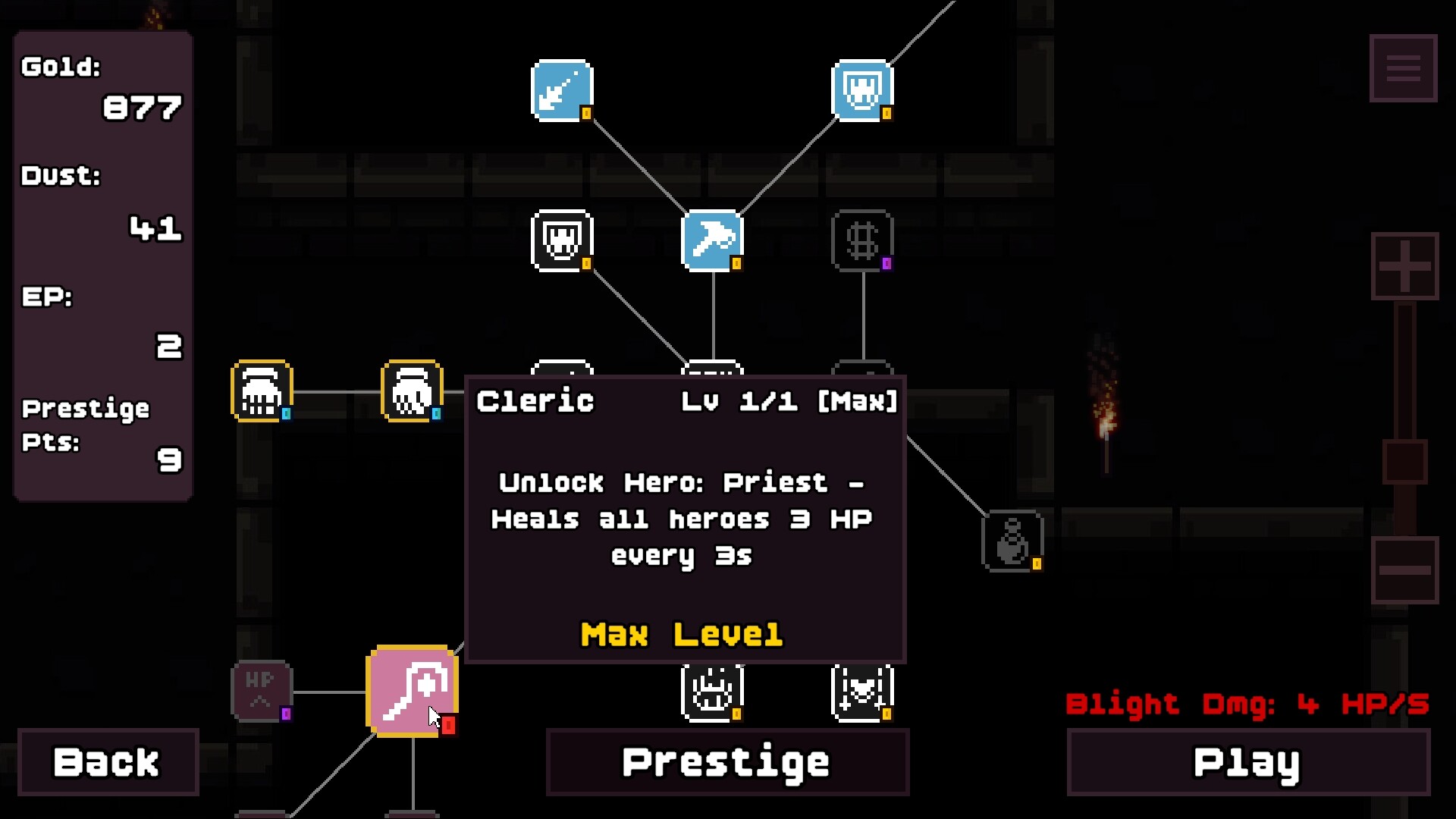
The official Cleric tooltip supplies another clear example. Its unlock identifies Priest and party healing, while the already-maxed pictured node does not display every earlier price. This separates what the node does from the expenditure history of that save, keeping a priority discussion focused on confirmed functions rather than guessed costs reconstructed from a resource sidebar.
Active abilities depend on the pace of the route
Both videos use temporary combat effects during dangerous attempts. Idle cub explicitly notices that moving through encounters more quickly changes whether an ability is ready at a later point. That is an observed interaction between different kinds of development, demonstrating why a purchase can alter the context of another part of the party's plan.
The result is not a universal argument against faster clearing. It is evidence that readiness, survival and pace are connected within the recorded route, rather than operating as independent upgrades with no consequences for one another. The sources support explaining that relationship while leaving a fixed optimal rotation or exact launch purchase schedule outside the claims they establish.
Sources
This article draws on the official descriptions, announcements, screenshots and recorded demo material below. Gameplay observations describe the demonstrations in those sources. Questions or corrections can be sent through the contact page.