
Loop Dungeon Incremental Team Synergy: Hero Interactions
Team synergy comes from complementary frontline, damage and support roles, combined with the timing of active skills. Both demo recordings show ranged attacks and healing supporting the warrior's progression. The developer also announces Activate as a Priest skill with further interactions, but the material does not specify a tested numerical combo formula.
Team Building · Reviewed October 16, 2026 · 1,192 words
At a glance
Interactions operate through the capabilities actually shown or described. The sources connect roles with party development and show active effects used during dangerous encounters. This provides a clear account of complementary functions without assigning a hidden numerical bonus to a character pair or treating every announced skill as an already tested combination.
| Topic | Documented information |
|---|---|
| Complementary roles | The official website combines frontline presence, offensive contribution and support in its party description. |
| Healing interaction | Both demos add a healing role while the rest of the party continues developing. |
| Timing interaction | Faster progression through rooms changes ability readiness in Idle cub’s documented run. |
On this page
Roles contribute to the same expedition
The official website describes frontline, damage and support responsibilities and says that composition and positioning shape fights. Both demo creators build toward those complementary functions instead of relying only on the opening warrior. This establishes synergy as a relationship between capabilities operating in one party, rather than a synonym for whichever character has the largest displayed damage value.
The party is also developing through repeated expeditions. Resource investments make further abilities possible, and those abilities alter what the group can accomplish on later attempts. That relationship is visible across both recordings, giving the team discussion a concrete progression context without requiring an invented bonus that activates simply because two particular hero names are selected together.
The warrior and ranged attacker contribute differently
Both videos show the player adding a ranged hero to the warrior's party. The creators then continue developing their offensive capabilities while reaching more demanding encounters. An official screenshot explicitly labels Archer, corroborating the named role in the game material rather than relying entirely on the automatic captions' variable archer and ranger wording.
Their improvement after that addition is a party-level observation within a changing save. The sources do not hold every other upgrade constant, so they do not isolate a precise damage multiplier attributable only to the pairing. What they demonstrate is two offensive contributors working through the same progression loop, while the official site supplies the broader context of heroes having different strengths and responsibilities.
Priest adds a documented healing function
The official Cleric tooltip identifies the unlocked hero as Priest and describes party healing. Both recordings introduce a healing role during their later development, providing gameplay context for that first-party description. This connects support with the party's endurance rather than making healing an assumed feature based only on how a character's artwork looks.
Rogue's footage also shows that adding healing does not end the need for further survival investment. The group continues developing defense and protective ability use as the encounters become harder. The supported interaction is therefore healing contributing alongside the party's other capabilities, rather than a claim that one support unlock permanently cancels every environmental or enemy threat.
Temporary buffs interact with the encounter
Both creators use a temporary warrior combat buff during boss progression. Idle cub experiments with its timing around the dragon, while Rogue also combines it with the party's other development. These are recorded examples of an active ability changing the conditions of a fight for a limited period, not evidence of an always-on increase that can be assumed throughout the entire expedition.
That limited period makes the timing of the encounter relevant. The player is still moving through rooms and meeting ordinary enemies before a boss, so readiness at the dangerous point becomes part of the recorded attempt. The sources support explaining that interaction while leaving exact universal cooldown sequences out of the guide, because the route and upgrades change during the videos.
Speed can change whether a combination is ready
Idle cub notices a concrete timing problem after increasing the pace of the run. The party reaches a later point more quickly, and an ability is not ready under the same conditions as before. This demonstrates that travel and clearing speed can interact with a combat plan, even though they are not themselves the same kind of temporary protective effect.
Rogue's later boss attempts also involve alternating protective abilities rather than treating each cast as independent of the next one. The shared lesson from the evidence is the relationship between ability windows and the actual flow of a fight. It does not establish a permanent rotation, a guaranteed invulnerability loop or a single timing rule for every composition in the complete game.
Mage and Activate expand the documented context
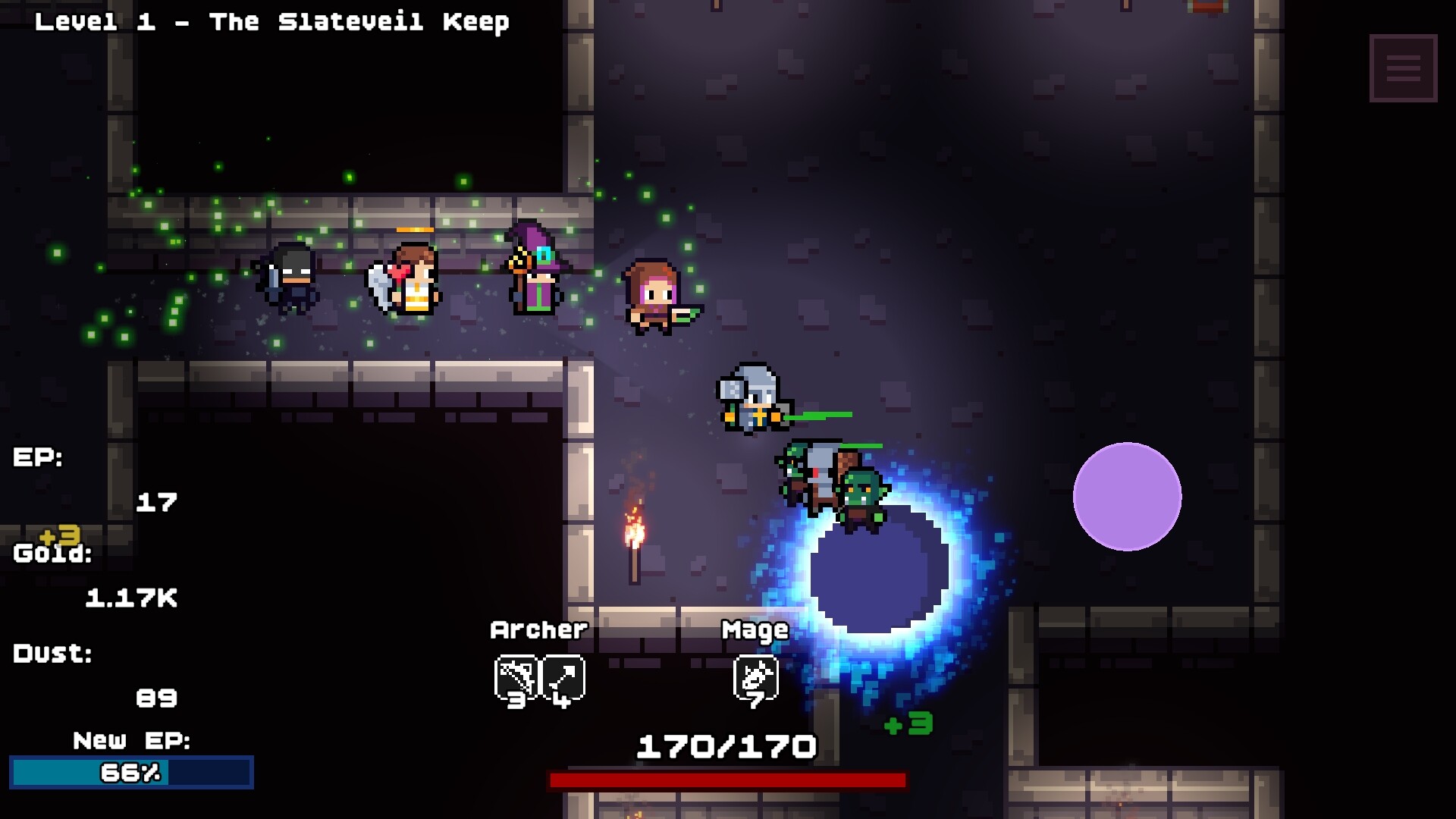
Current official promotional material includes a Mage skill label alongside Archer. That confirms another offensive skill group in the promoted game, while the image does not publish a full tested set of Mage interactions. The screenshot is therefore useful for understanding that the older party examples are incomplete, but not for inventing a specific elemental or cooldown combination.
The release announcement separately introduces Activate for Priest and says it can interact with other heroes' skills. That is a developer-described feature, not a demonstration of an exact reset, refresh or multiplier mechanic. The guide can name the announced interaction accurately while leaving out a supposedly optimal Mage pairing or any numerical behavior that the collected material does not specify.
A party example is not a universal synergy ranking
The recordings provide a concrete three-role group, and the official description explains why complementary responsibilities matter. Together, those sources establish a clear framework for reading the party's development and its active decisions. They do not compare every available pairing under equal conditions or provide separate best-combination tables for every dungeon, farming goal and boss.
That distinction keeps the answer useful without overstating it. Damage, frontline presence, healing and temporary protection all contribute to the documented attempts, while the route's pace changes how those contributions line up. The verified account describes those actual relationships, rather than turning the word synergy into a promise of a hidden multiplier or an unbeatable team that the sources never demonstrate.
Collection and income also support the party indirectly
Both creators spend resources on development while building their groups. Gold and magic dust remain distinct in the recordings, and official screenshots display several point counters separately. That resource layer explains how further combat and support capabilities become available without being itself a hidden party-composition bonus attached to a pair of characters.
Magnetism provides a concrete example of another separate function. Its official tooltip concerns collecting on-screen gold and items, while the July patch confirms an auto-pickup reward skill. Collection convenience supports the broader loop, but it does not establish a combat multiplier between heroes, so it belongs beside the party discussion rather than inside an invented damage formula.
Role names should not create extra characters
The official Cleric tooltip names Priest as the unlocked hero. Those are two labels within the same interface relationship, not independent evidence of two separate healers available for a double-support composition. This matters when interpreting automatic captions, whose variations could otherwise make a party look as though it contains more confirmed options than the sources actually identify.
Current gameplay material also explicitly labels Archer and Mage skill groups. Those labels corroborate named parts of the promoted party, while the screenshot alone does not show a complete roster or every compatible interaction. Reading each name in its actual context keeps the synergy explanation tied to documented characters rather than combinations assembled from transcription differences.
Sources
This article draws on the official descriptions, announcements, screenshots and recorded demo material below. Gameplay observations describe the demonstrations in those sources. Questions or corrections can be sent through the contact page.