
Loop Dungeon Best Team: Demo Parties and Hero Roles
The demonstrated demo party combines a frontline warrior, a ranged attacker and a healer. Both English creators develop that combination, and the official website describes the same complementary responsibilities. It is a supported example rather than a proven best launch team, especially because current material also includes Mage and the announced Rogue.
Team Building · Reviewed October 16, 2026 · 1,194 words
At a glance
The documented group contains complementary functions rather than a published global rating. Both creators assemble those functions through progression, and the official website explains their broader party roles. This makes the composition a useful concrete example while keeping the characters and their changing upgrades attached to the conditions shown in the footage.
| Topic | Documented information |
|---|---|
| Warrior | The opening party develops a frontline contribution and uses a temporary combat buff. |
| Archer | The added ranged role contributes to the party as later clearing abilities develop. |
| Priest | The healing hero adds support while defense and protective ability development continue. |
On this page
A working demo party is the clearest starting answer
Both recorded playthroughs move beyond the opening warrior by adding ranged damage and later healing. The resulting party has several ways to contribute during a run, rather than depending only on the player's opening click damage. That progression is directly observed in separate videos and fits the official description of recruiting heroes with different strengths and roles.
The strongest defensible team statement is that this composition works in those demonstrated demos. Neither recording compares every available hero with equal investment on the same route. A claim that the trio is universally best would therefore go beyond the evidence, while describing its complementary functions gives the player a concrete party example without inventing a ranking.
Frontline presence and temporary protection
The warrior is present at the beginning of both videos and remains part of the later party. The recordings develop its combat capabilities and use a temporary warrior buff around dangerous fights. This provides a documented connection between the frontline role, survival-related development and active decisions during boss attempts, rather than reducing the character to an assumed damage label.
The official website explicitly includes frontline responsibilities when describing party composition. That confirms the role as part of the game's intended structure, while the playthroughs show it operating beside other characters. The evidence does not establish a universal defense threshold or an unavoidable slot rule, so the warrior's documented contribution should be described through those observed responsibilities rather than a fictional mandatory-team formula.
Ranged damage changes the opening party
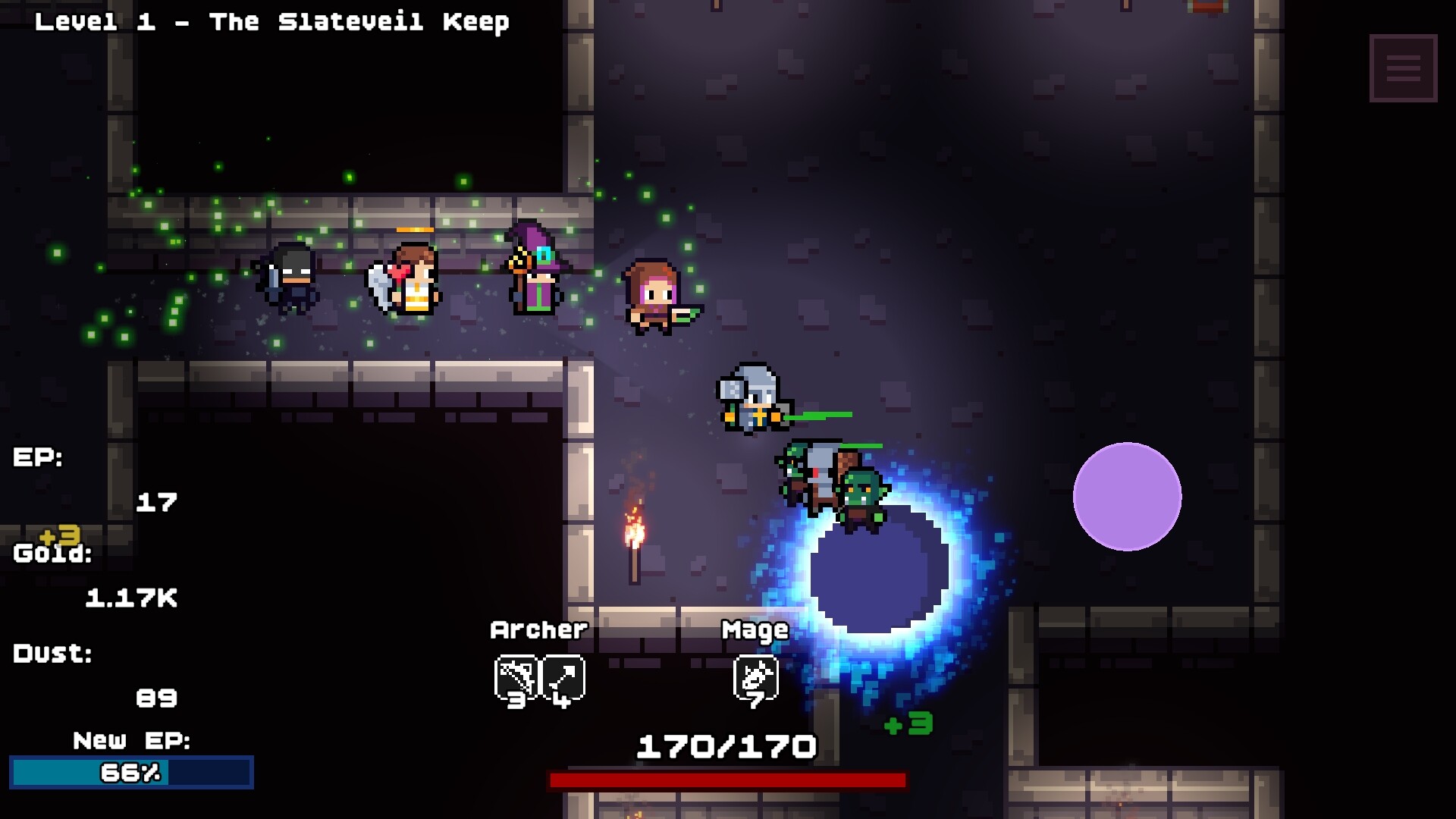
Both creators observe stronger clearing after adding the ranged attacker. Their parties gain another offensive contribution working alongside the warrior, and later development expands the ranged character's capabilities. An official screenshot explicitly labels Archer, giving this part of the team a visual identity beyond the changing wording of automatic captions.
The improvement happens within a developing save. Other upgrades continue changing around it, so the footage does not isolate a precise contribution that can be compared against every other damage hero. What is confirmed is the role's presence in a successful demo composition, while a claim that it always provides the highest damage per resource would require a different kind of test.
Healing supports endurance without erasing every threat
The healer appears after further progression in both recordings. The official tooltip calls its unlock node Cleric and identifies the unlocked hero as Priest, describing healing for the party. This is a clearly documented support function and a reason the later group behaves differently from the opening party that had only the warrior and player input.
The footage also shows further survival investment after healing becomes available. Rogue still develops defense and protective ability use while attempting harder content, so the healer is part of a broader survival solution. Its presence should not be expanded into a claim that environmental pressure disappears entirely or that the group can ignore the demands of every boss and area.
Farming and boss attempts emphasize different interactions
The recorded farming loops combine income development with the party's ability to clear larger groups and move through encounters. Boss attempts put more emphasis on remaining alive and timing temporary effects around a dangerous fight. Those are different immediate demands shown within the same playthrough, even when the creator is using the same developing set of heroes.
This explains why a useful team discussion needs more than one damage label. A party's support and defensive contributions appear alongside its ability to defeat enemies, while resource development determines what improvements are available later. The sources support describing those interactions, but do not provide separate verified best-team rankings for every stage, farming route or boss in the launch version.
Mage and Rogue broaden the promoted options
Current official gameplay material includes a Mage skill label alongside Archer. The later release announcement also introduces the Rogue as a damage-focused character with Blink Attack. These are confirmed additions to the information available about the game, showing why the July core trio should not be treated as a complete roster merely because it is prominent in the English videos.
The developer also announces the Priest's Activate skill and describes interactions with other heroes' abilities. That statement establishes an intended source of further party combinations, without publishing the exact numerical relationships needed for a comparative team calculation. The promoted options can therefore be named accurately while their untested performance is left out of the recommendation rather than guessed from a skill description.
Keep party evidence separate from a fixed slot list
The official website says positioning and composition shape fights. That makes role relationships part of the game, but it does not by itself establish a universal party-size limit or a required set of slots. A screenshot with several characters demonstrates what the image contains, not every rule governing which group a player must use in all content.
The reliable answer stays tied to the available demonstrations. Frontline presence, ranged damage and healing are the complementary functions assembled in both recordings, while additional heroes appear in later official material. This gives the player a grounded explanation of the documented team without claiming that a changing demo group is the final or optimal composition for the complete game.
A developed party is more than its character names
The creators continue buying upgrades after the ranged attacker and healer join. Their later groups therefore reflect both composition and the history of resources invested in combat, sustain and abilities. The same names appearing together at different points in a recording do not establish that the party has identical capabilities or will perform the same way on every attempt.
This is one reason the sources cannot turn a successful demonstration into a universal ranking. The official website connects team choices with fights, while the videos show those choices embedded in broader progression. A useful account of the demonstrated party includes that relationship rather than treating the list of names as a complete explanation of its result.
Active effects connect roles during dangerous fights
Both recordings use the warrior's temporary combat buff, and later footage includes healing and protective ability use around bosses. Those actions take place within the same party rather than as unrelated character demonstrations. The documented interaction is that several capabilities contribute during a limited encounter window, while their readiness depends on the route taken to reach it.
The release announcement's Activate description adds a further developer-stated interaction for Priest. It does not specify a full numerical combo, so it should not be substituted for a tested rotation or a guaranteed team bonus. The supported team explanation names the actual role contributions and announced features without adding hidden synergy rules that the material never describes.
Sources
This article draws on the official descriptions, announcements, screenshots and recorded demo material below. Gameplay observations describe the demonstrations in those sources. Questions or corrections can be sent through the contact page.