
Loop Dungeon Incremental Permanent Upgrades Explained
Permanent growth and prestige benefits are officially confirmed, but they describe more than one progression boundary. Both demos preserve development across ordinary attempts and rebuild ordinary progression after prestige. A complete item-by-item launch carryover table is not established by these sources, so the distinction between those events is the central answer.
Upgrades · Reviewed October 16, 2026 · 1,191 words
At a glance
The word permanent becomes clearer when each boundary is named. The collected sources describe development between runs, rebuilding through prestige and a separate migration into the full game. These events all involve progress, but their confirmed behavior should remain attached to the specific action rather than being combined into one universal retention promise.
| Topic | Documented information |
|---|---|
| Ordinary expedition | Resources and purchases contribute to the next run in the recorded progression loop. |
| Prestige reset | Both demos rebuild ordinary development after confirming the broader reset. |
| Version transfer | The newer announcement describes one-time full migration for compatible Demo 0.9.0 onward saves. |
On this page
Ordinary runs feed a lasting development loop
The store describes every expedition as contributing to long-term growth through resources and improvements. Both English recordings show that structure repeatedly: the player completes another short attempt, returns to the tree and spends resources on further development. The next expedition then takes place with the changed capabilities created by those purchases rather than simply repeating the untouched opening state.
This is the most direct meaning of lasting development in the recorded early game. Short runs can contribute to later progress even before the party reaches a boss or another area. The official description and the independent playthroughs therefore agree on the relationship between repeated expeditions and growth, without requiring a claim that every purchased value survives every possible reset.
Prestige introduces a different boundary
Both videos eventually use prestige after an initial level clear. The recordings then show renewed development through the tree, making the result visibly different from an ordinary return between expeditions. That before-and-after sequence establishes why prestige needs its own explanation instead of being treated as another name for the end of a regular run.
The official store describes prestige bonuses as helping progression continue after a reset. The developer website similarly connects prestige and long-term strength with reaching deeper content. Those descriptions establish a lasting benefit to the broader loop, while the actual recordings show that ordinary development still has to be rebuilt, so the word permanent cannot be applied indiscriminately to every node.
Resource counters describe separate layers
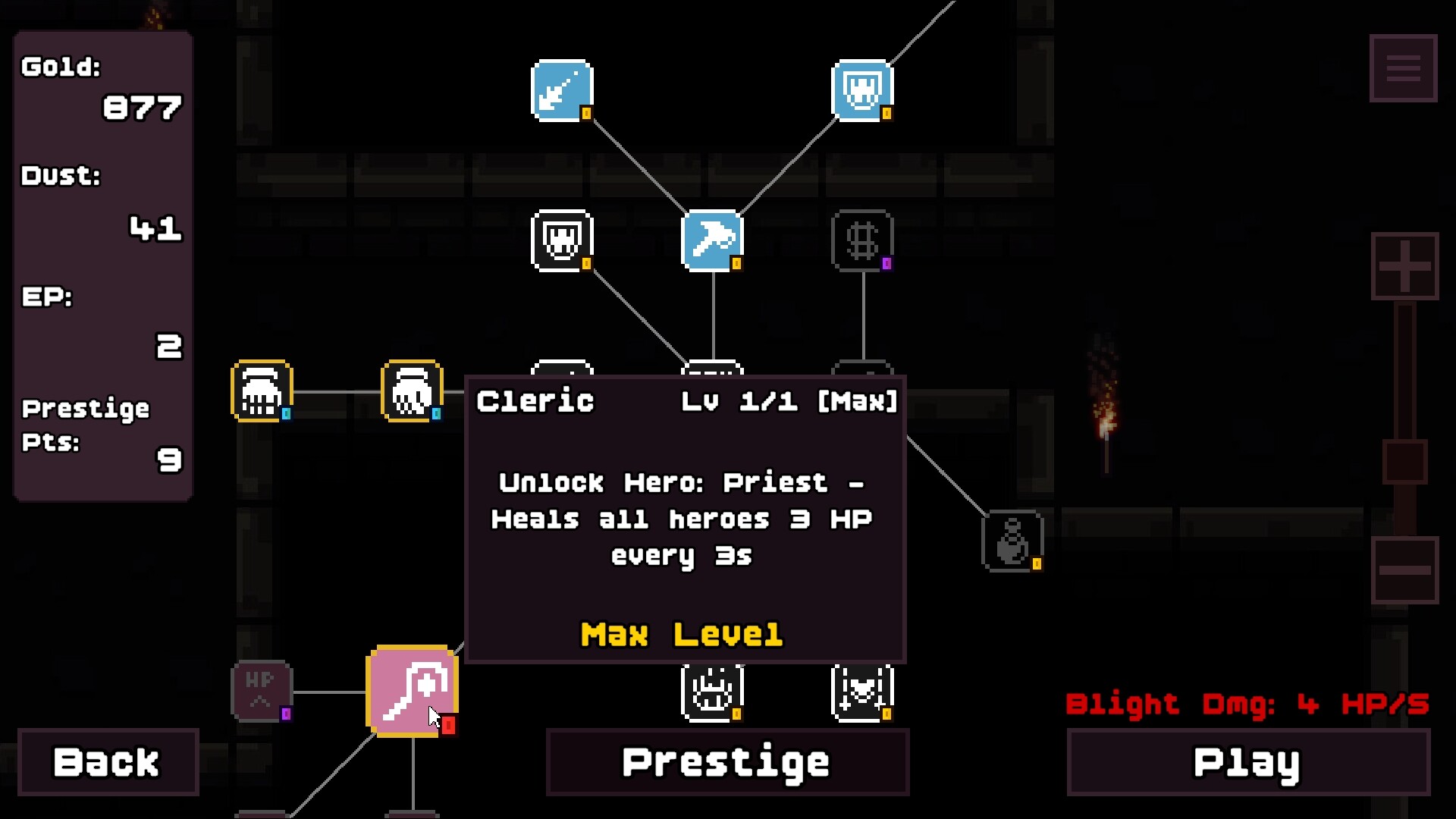
The official tree screenshot displays Gold, Dust, EP and Prestige Pts as distinct counters. Both recordings also distinguish currencies and points while developing the party through different stages of the demo. Their separation is relevant to the persistence question because several kinds of progression appear together in the interface without necessarily being governed by one identical rule.
A still image does not show what happens to each counter when a reset is confirmed. Its balances establish the state of a promotional save, not a full description of how that state was reached or what will remain afterward. The videos provide the stronger evidence for rebuilding after prestige, while neither source supplies an exhaustive current retention table for every resource and unlock.
Hero development illustrates the distinction
The recorded parties expand through skill-tree unlocks, with a ranged attacker and later a healing role joining the warrior. After prestige, the creators revisit party development during their rebuilding sequences. This makes hero progression part of the observed reset context rather than a separate system that can automatically be assumed to remain identical through every transition.
The official Cleric tooltip identifies Priest as the unlocked hero and describes party healing. Because that pictured node is maxed, it confirms the node's identity and function rather than every purchase required to obtain it. Combining the screenshot with the recordings clarifies what is being developed, but does not justify a blanket promise that all hero-related progression is permanently retained through prestige.
The updated prestige display has a defined purpose
The developer revised prestige information in update 0.1.8. The same update added resource-type information to skill-node tooltips, making the interface more explicit about progression and expenditure. These are published usability changes, showing that the displayed information around a decision is part of understanding how the next step works.
They also explain why an old numerical preview should not be treated as a complete general rule. A creator's prestige screen describes the state and available result of that particular recorded save. It does not automatically publish the outcome for every other version, stage or combination of purchases, especially when the developer's later announcement expands the full game beyond the demo content shown.
Demo save transfer is another separate event
The later developer announcement addresses moving demo progress into the full game. It permits full one-time migration from Demo 0.9.0 onward and provides a compensation choice for older demo progress. Those are explicit version-transfer rules, not a list of the ordinary tree purchases that persist when the player uses prestige inside the game.
The difference can be seen in the evidence used for each topic. The videos demonstrate in-demo resets and rebuilding, while the release announcement describes a check for a compatible save at the first full-game launch. Treating those as one reset system would combine different actions and could make a true statement about one event into a misleading claim about the other.
What the confirmed persistence story actually establishes
There is lasting development between expeditions, a prestige layer that supports further growth and a separately announced demo migration policy. These three facts are supported by official descriptions, developer notices and the recorded progression sequence. They give the player a clear explanation of the different boundaries without inventing an unsupported yes-or-no retention entry for every visible node.
The complete-game context remains part of that explanation. The developer announces additional heroes, skills, bosses and levels beyond the older demos, so those recordings document a particular stage of the game's development rather than a final database. This page keeps the persistence claims at the level the sources establish, distinguishing observed rebuilding and announced transfer rules from a broader carryover table the material does not provide.
Collection upgrades illustrate function without proving retention
The official Magnetism image describes automatic collection of on-screen gold and items. The July patch also confirms an auto-pickup reward skill, making collection convenience a documented part of the upgrade system. Its effect can be explained directly without inventing a gear item or assuming that every improvement serves the same combat purpose.
That confirmed function does not answer every persistence question about the node. A tooltip describes what the ability does in the pictured state, while a reset sequence would be needed to show exactly what happens to that purchase afterward. Keeping effect and retention separate prevents a correct skill description from becoming an unsupported promise about every later prestige cycle.
The different documents answer different persistence questions
The store and developer website explain the intended lasting-growth loop. The demo videos show purchases and rebuilding through an actual recorded reset, while the later release notice explains a version-transfer policy. These sources complement each other, but none should be asked to prove a different event simply because all involve some form of continued progress.
Their combined picture is more precise than one general statement that nothing is ever lost. Ordinary runs contribute to development, prestige changes that development state and compatible demo migration is a separate one-time choice. Those are the documented boundaries a player can distinguish from the material without adding a fictional retention table for currencies, hero unlocks or individual nodes.
Sources
This article draws on the official descriptions, announcements, screenshots and recorded demo material below. Gameplay observations describe the demonstrations in those sources. Questions or corrections can be sent through the contact page.