
Loop Dungeon Incremental Progression Guide: Next Steps
The demonstrated progression moves from short warrior runs to additional heroes, a dragon clear, prestige and a harder area. Both recorded playthroughs develop damage, survival and resource income along that route. Their demo endpoints document a real early-game sequence, while the developer's full-game announcement confirms additional content beyond those recordings.
Guide · Reviewed October 16, 2026 · 1,182 words
At a glance
The demonstrated route has milestones with different meanings. Adding a role changes the party, clearing a boss opens another context and prestige changes ordinary development. These distinctions help describe what actually advances in the videos without turning their particular ending into a claim about the complete release.
| Topic | Documented information |
|---|---|
| Party milestone | A ranged attacker and healing role expand the capabilities of the opening group. |
| Encounter milestone | The dragon and later demon are both encountered in the English demo recordings. |
| Reset milestone | The first prestige cycle begins another period of tree development and party rebuilding. |
On this page
The opening milestone is a more productive run
Both creators begin with a party that cannot advance very far. Manual clicking supplements the warrior's attacks, and early purchases make subsequent attempts last longer or defeat enemies more effectively. The first clear sign of progression is therefore a change in what a repeated attempt accomplishes, before the player reaches a new boss or unlocks another area.
The official description connects that pattern to resource collection and improvements between expeditions. It presents repeated growth as the game's central structure, rather than promising continuous forward movement on every attempt. The videos show the practical result: short expeditions remain part of advancement because they feed later purchases in the same developing skill tree.
Additional heroes change the party's capabilities
Both recordings obtain a ranged attacker through a skill-tree option. After that unlock, the creator's party has another source of damage working alongside the warrior instead of relying on the opening combination alone. This is a distinct progression milestone because it changes the party's composition, not merely a displayed statistic on an existing character.
The healing role appears as another important development in the recorded route. Official screenshots identify its unlock node as Cleric and the resulting hero as Priest, which resolves the difference between the two names used around that part of the tree. The tooltip confirms party healing, giving the new role a documented purpose without requiring an invented ranking of every character.
The dragon tests whether the party can survive a clear
The dragon appears in both English demo playthroughs and is explicitly labelled in an official Level 1 screenshot. Both creators spend several attempts developing the party before clearing the encounter. Their runs combine combat investment with improved survivability, demonstrating why reaching a boss and finishing its fight are separate steps in progression.
Temporary abilities also become part of those attempts. The creators time the warrior's combat buff around the encounter, while later play incorporates healing and protection. This makes the first significant clear a test of the party's combined development, rather than evidence that one exact damage number or a single hero unlock guarantees victory in every version.
A newly available area brings a different pressure
After the first clear, the recordings move into an area that the existing party finds much harsher. Rogue explicitly compares its poor results with the previous area and returns to earlier farming. The sequence demonstrates that unlocking the next destination and handling it comfortably are distinct stages of development, even when the destination can already be selected.
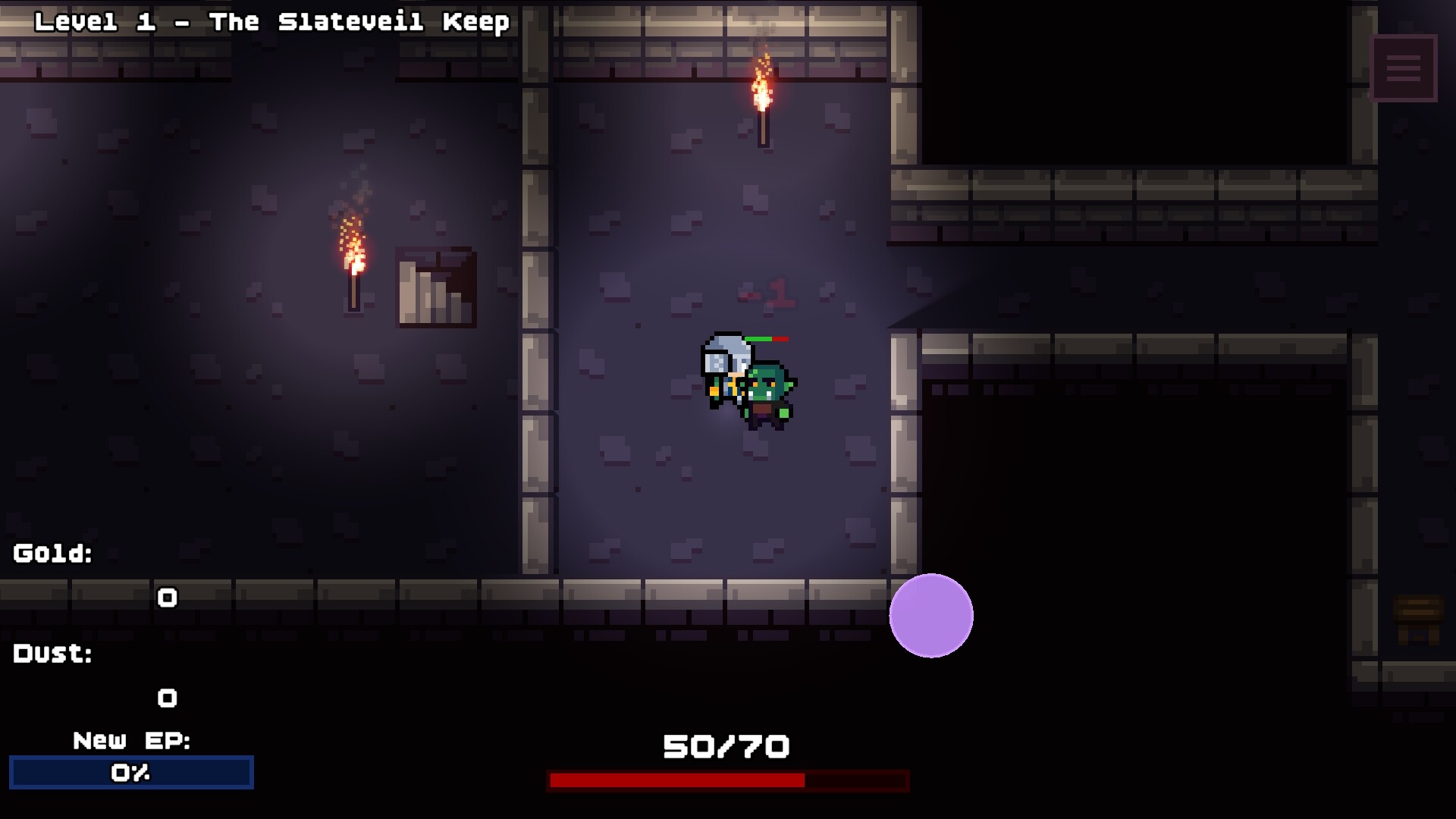
Current official screenshots also show a stage-selection interface with different environmental HP loss between entries. The pictured names include The Slateveil Keep, The Gloamstone Crypt and The Ember Bastion. Those names should be kept in their screenshot context because the older video captions use different wording, and merging the two sets would create an unsupported map of the complete game.
Prestige starts another development cycle
The initial prestige follows a first-level clear in both videos. After the reset, the creators rebuild ordinary progression and move toward further party development through the tree. This is a larger transition than finishing an individual expedition, because the before-and-after footage shows a changed state of progression rather than simply another run with the same purchases.
The store and developer website describe lasting growth through prestige. That description gives the reset a clear role in reaching deeper content, while the footage demonstrates that ordinary development still has to be rebuilt afterward. It does not establish a complete list of everything carried through each reset, so the recorded sequence should be read as an early progression example rather than a full retention specification.
Later demo fights demand more of the party
Both recordings eventually reach a demon encounter after the earlier dragon. Their later attempts involve additional combat investment, stronger healing and protective ability use, connecting the new fight to the systems already introduced. The demon is therefore a documented later demo obstacle, rather than a guessed enemy added to complete a boss list.
Both creators finish their demonstrated demo content after overcoming that later fight. Those endings show what each recording reached, but they do not measure the full campaign or establish a final boss for the release version. The developer explicitly announced more bosses and levels, which places the July videos within a broader game rather than making them an exhaustive walkthrough.
Keep progression goals separate from farming goals
The recorded route repeatedly alternates between developing resources and attempting a new clear. A productive farming loop supplies further development, while a pushing attempt tests whether the current party can reach the next milestone. Rogue's return to an earlier area is a concrete example of those goals changing within the same playthrough rather than a contradiction in how the game progresses.
This distinction also keeps the guide connected to the player's immediate question. A party struggling before a boss is in a different situation from one comfortably repeating an earlier route, even if both can select the same areas. The evidence describes those different states clearly, while leaving exact launch-stage thresholds and a universal fastest route outside the claims made by the collected sources.
Resource development accompanies each milestone
Both creators work on income-related capabilities while developing their combat parties. Gold and magic dust matter at different points as the tree opens, and larger enemy groups become part of the recorded route. These observations connect resource growth with later progress rather than presenting a new area as something reached only through a single damage statistic.
The official counters also distinguish EP and Prestige Pts from the collected resources. That interface detail helps explain why different forms of progression appear side by side during the videos. It does not establish a universal conversion among them, but it supports describing advancement as several connected layers instead of treating every visible balance as identical money.
The full-game announcement broadens the route
The developer introduces a damage-focused Rogue with Blink Attack and a new Priest skill called Activate. Current official combat material also labels Mage, beyond the core party emphasized in the older English recordings. Those are confirmed additions to the information about the game, which makes the July route an example rather than the entire set of promoted possibilities.
Their existence does not establish every later unlock condition or encounter sequence. A screenshot identifies what it displays, while an announcement identifies what the developer says is being added. Keeping those facts separate from the observed demo route allows a progression guide to describe real milestones without pretending that all the available materials document one complete, identical release playthrough.
Sources
This article draws on the official descriptions, announcements, screenshots and recorded demo material below. Gameplay observations describe the demonstrations in those sources. Questions or corrections can be sent through the contact page.