
Loop Dungeon Incremental Builds: Skills and Playstyles
The recorded demos support several investment directions: manual click assistance, party combat and sustain, and resource-focused development. Both creators move between those priorities as their parties change. These are documented approaches to the skill tree, not tested launch presets, equipment sets or a published best-build ranking.
Team Building · Reviewed October 16, 2026 · 1,170 words
At a glance
The recorded investment directions overlap within the same save. Both creators develop player assistance, hero capabilities and resource income rather than selecting a documented fixed preset at the start. The table describes those actual functions, keeping a build direction separate from an invented talent string or a named equipment set.
| Topic | Documented information |
|---|---|
| Player assistance | Manual clicks supplement automatic combat during the documented opening encounters. |
| Party development | The videos add ranged damage and healing while improving the existing group. |
| Resource development | Income-related purchases support the resources needed for further tree progression. |
On this page
A build develops through connected purchases
The official store connects active optimization, party management and lasting upgrades. Both videos show those ideas through a branching tree that changes what the player and heroes can do over successive runs. A build is therefore visible as a developing combination of capabilities, rather than only a character name or one isolated damage value.
The recorded purchases also serve different purposes. Some help the player contribute directly, some strengthen individual heroes and others affect the resources that support future development. Keeping those functions distinct gives a more accurate picture of the tree than treating every node as another version of the same combat increase or assigning all purchases to an invented equipment loadout.
Manual input supports the earliest combat
Both playthroughs begin with player clicks supplementing the warrior. The demo announcement explicitly confirms that combination of automatic battles and manual clicking, making direct player assistance a documented part of the opening loop. The early footage then develops click-related capabilities alongside the party's own improvements rather than presenting those paths as completely separate games.
Rogue later compares investment in the cursor with investment in the characters. That is an observed change of emphasis as the party grows, not a controlled proof that one direction always dominates the other. The useful distinction is the source of the contribution: the player's active input and the heroes' attacks both appear in the material, while their exact comparative value depends on conditions the sources do not isolate.
Party combat adds several complementary roles
The videos add a ranged attacker and a healer around the existing warrior. Their later attempts therefore develop a group with more than one offensive contribution and a support function, matching the official site's frontline, damage and support description. This creates a party-focused direction within the tree that is supported by both gameplay evidence and first-party explanation.
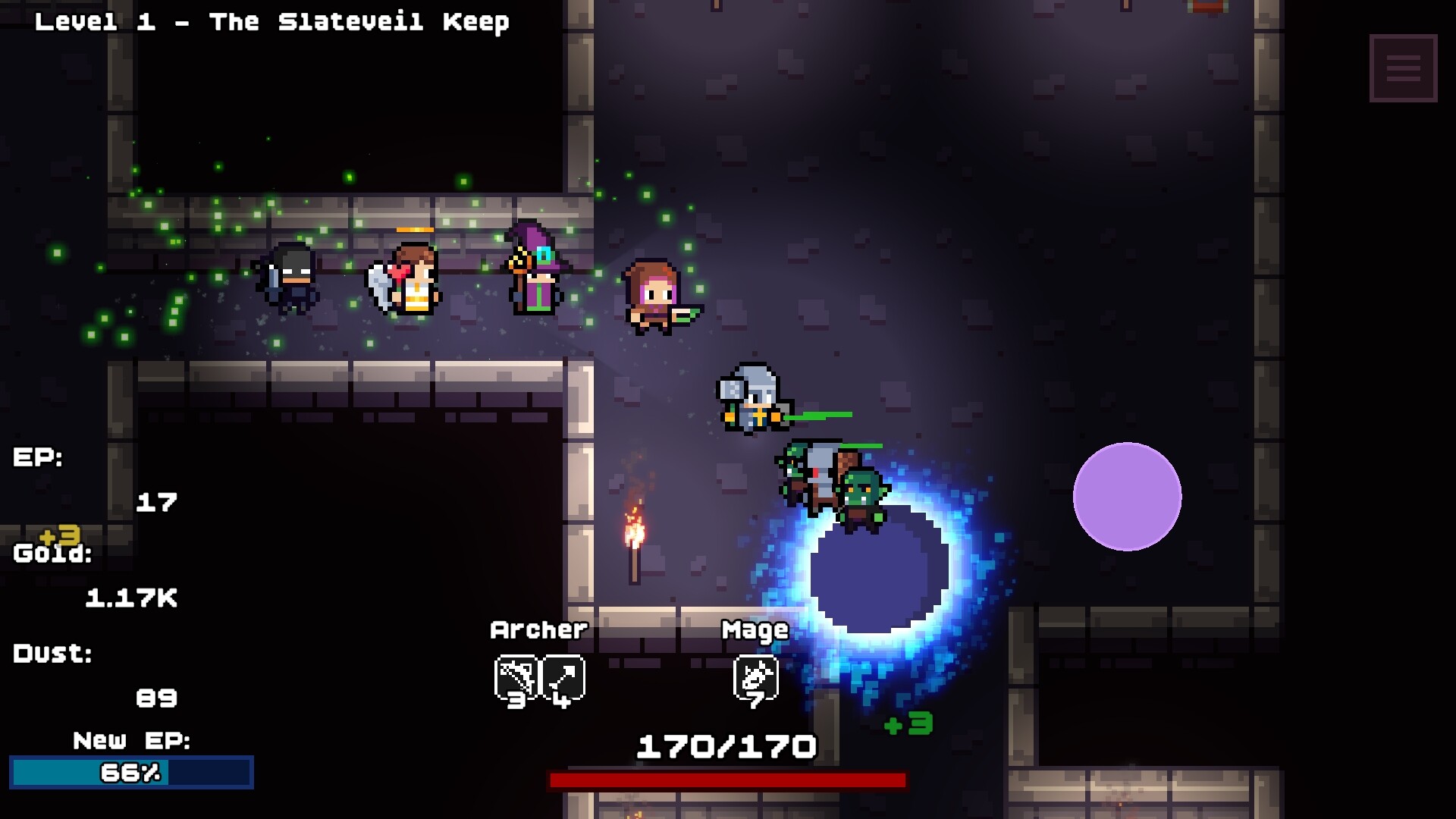
Official screenshots further identify Archer and Mage skill groups. Another tooltip labels the healing unlock node Cleric while naming the hero Priest, giving the support role a specific interface identity. These details support role-specific discussion without supplying a complete launch skill allocation, an equal-investment damage comparison or an exact acquisition path for every character pictured.
Resource investment supports later capabilities
Both creators develop income-related nodes while working toward more demanding content. Their recordings distinguish gold from magic dust and show those resources becoming relevant to different purchases as the tree opens. Economy development is therefore part of the observed build process, because it changes the resources available for later combat and support improvements.
That direction is not the same as a named gear set. The official screenshots show resource counters and skill nodes, while the collected store description does not publish a complete equipment catalogue. Describing an income-focused period of development is supported by the footage; inventing an item combination or claiming a particular weapon rarity from that same evidence would be a different and unsupported statement.
Group clearing appears as the party expands
Both videos develop larger enemy groups during the demo. Their later commentary also discusses ways of clearing multiple enemies, connecting the demands of a wave with the party's available offensive tools. This provides an observed context for area-oriented development without requiring a fictional talent string or a complete skill planner.
Rogue's later run includes piercing-based clearing, while Idle cub also discusses how the pace of group kills affects the loop. Those examples establish that group handling becomes relevant to the recorded party's development. They do not establish a universal best allocation for every hero, because each creator's other purchases and route conditions continue changing while those abilities are introduced.
Boss sustain becomes another documented emphasis
The dragon and demon attempts involve development of survivability as well as damage. Both creators use the warrior's temporary buff around dangerous encounters, and Rogue later combines healing and protection while working toward a clear. This is a distinct emphasis within the observed progression, where keeping the party alive contributes to completing a fight rather than only shortening it.
The recordings also show ability timing changing across attempts. Faster movement can alter whether an effect is ready when the party reaches the next encounter, as Idle cub explicitly notices. A build description therefore needs to account for interactions between pace and readiness, instead of assuming that every improvement operates independently or that one fixed ability sequence fits every version of the route.
Distinguish convenience nodes from combat effects
The official Magnetism tooltip describes automatic collection of on-screen gold and items. The July patch also confirms an automatic reward-pickup skill and continued background running. These are real progression features, but they describe convenience and application behavior rather than a published damage multiplier or a guarantee of rewards while the game is closed.
The developer's later announcement adds further version context by introducing Rogue and the Priest's Activate skill. Those additions mean the older recordings do not contain every combination planned for the full release. The supported build discussion is consequently a set of demonstrated development directions, while exact launch presets, respec rules and complete talent allocations remain outside the factual claims presented here.
The tree distinguishes resource types as well as effects
Official screenshots label Gold, Dust, EP and Prestige Pts separately. The June update also adds currency-type information to node tooltips, making the resource requirement an explicit part of reading a purchase. Those details matter to a build because different improvements can concern different expenditures even when their icons appear close together in the same tree.
The visible balances still describe only the pictured save. A maxed node does not reveal every cost previously paid, and the presence of another resource elsewhere on the screen does not price that node. This keeps the build explanation grounded in the documented interface without inventing an allocation budget or treating every upgrade as a trade against one identical pool.
Prestige changes the development state
Both creators rebuild ordinary progression after using prestige. The store describes lasting benefits from that reset, while the recordings show renewed purchases and party development afterward. That larger transition changes the context in which a build is being developed, rather than simply adding another ordinary run to an unchanged set of capabilities.
It also separates a demo example from a permanent full-game preset. The release announcement adds heroes, skills, bosses and levels beyond the old recordings, while the initial reset examples cover only the progression shown there. A build discussion based on these sources can describe real development directions without pretending that one completed demo allocation is the complete release configuration.
Sources
This article draws on the official descriptions, announcements, screenshots and recorded demo material below. Gameplay observations describe the demonstrations in those sources. Questions or corrections can be sent through the contact page.